
Arti Lens
On this page20
What Arti Lens does
Open Arti Lens in the sidebar (/webapp/arti-lens). Arti Lens reads the artifacts in your account file — import your SWEX JSON (see the SWEX guide) or keep it up to date with SWLens Connect in the desktop client. Artifacts drop in Steel Fortress and Punisher’s Crypt. The page has three tabs, and every artifact names its best monsters:
Artifact analytics
Convert & reappraise
Arti Lens overlay
Best monsters
How artifacts work in Summoners War
Artifacts are a second kind of gear, worn on top of runes and only by 6★ monsters: each monster has two artifact slots. In brief:
Arti Lens reads these parts on every artifact in your account file; the sections below show how it judges them.
The two scores
Every artifact shows two numbers:
On an artifact’s card each line shows its rolls (“2 rolls of 4 possible”) and how good it is for those rolls; a line that no longer drops on new artifacts is marked old, and a converted line is marked too.
Keep, Convert, Sell — and Refine
Each artifact gets one verdict, with its reason in plain words:
Example reasons: “Its lines work well on monsters in the game.”, “In use on your monsters: never sold here.”, “A conversion would make it worth keeping.” or “Under your keep line, and no conversion lifts it over.”
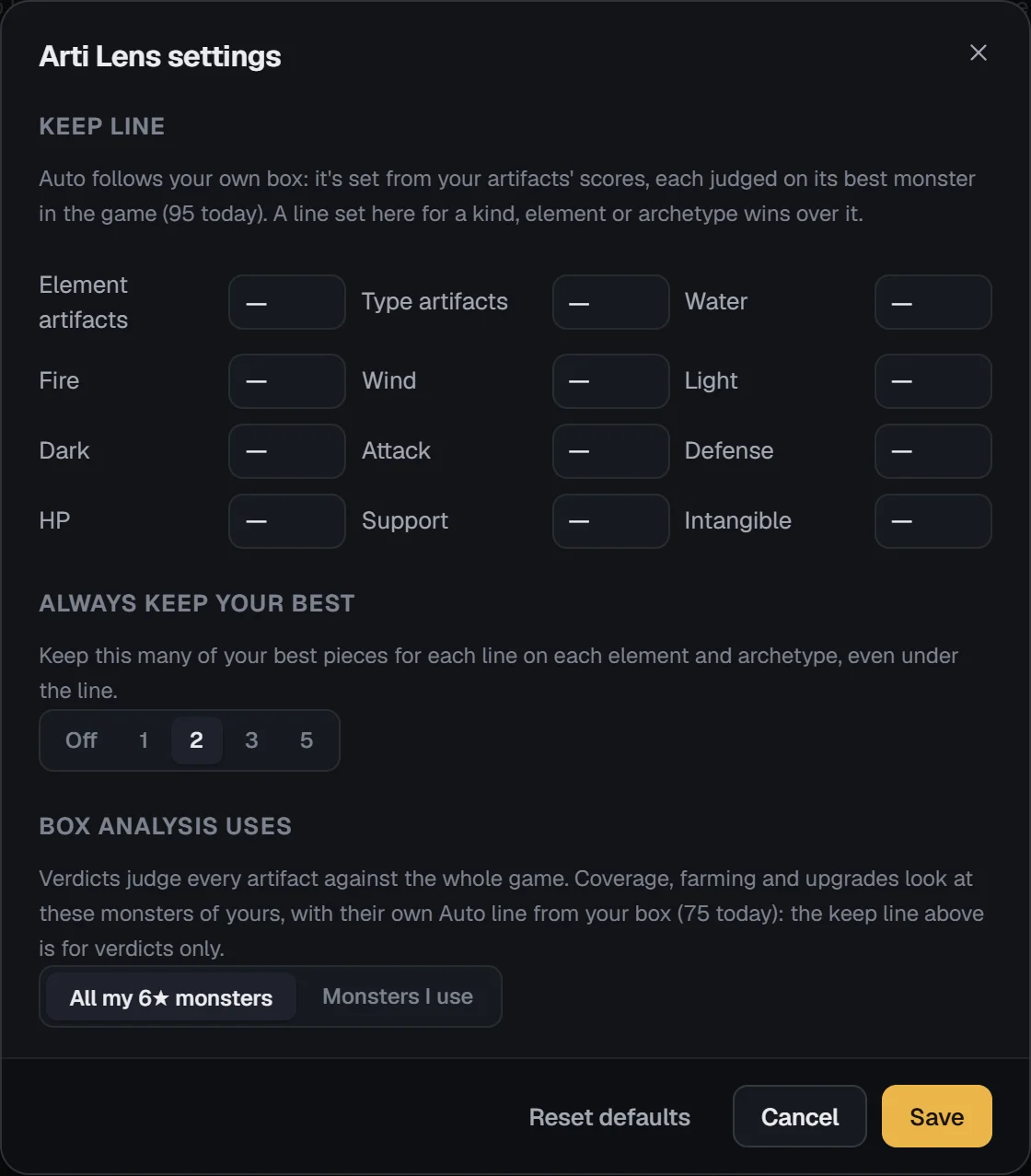
The keep line and Arti Lens settings
The keep line bar sits on top of Artifact analytics: Auto or Manual, with the line’s value, and Settings (Arti Lens settings):
Reset defaults goes back to Auto and the default settings.
Artifact analytics
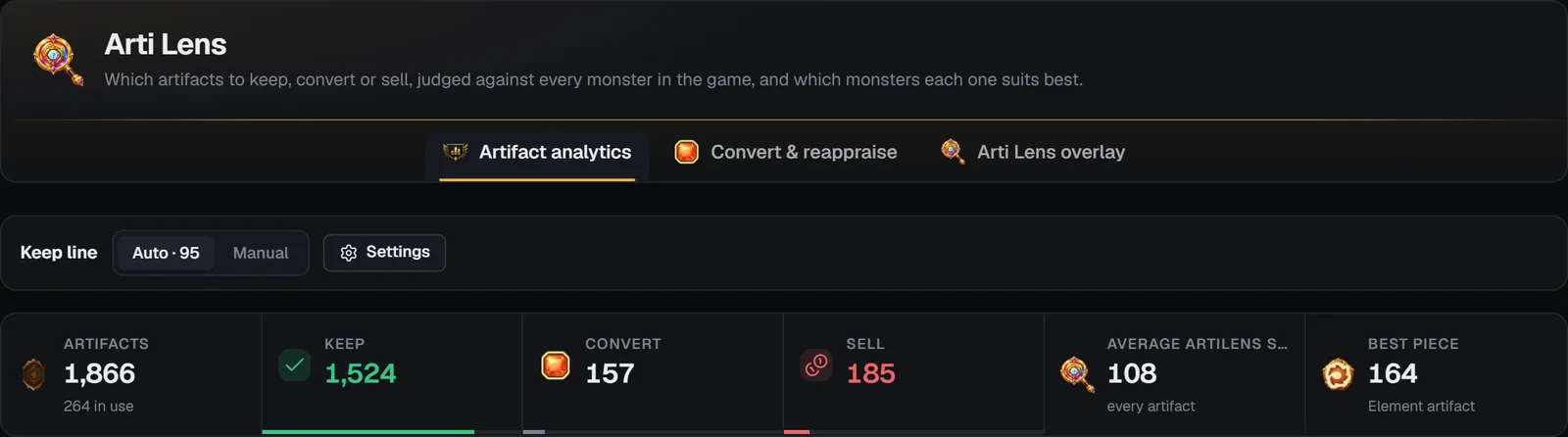
Artifact analytics is the tab the page opens on. Under the keep line bar, a strip of highlights:
- Artifacts — how many you own, and how many are in use.
- Keep, Convert and Sell — each count with its share; click one to list those artifacts.
- Average ArtiLens score — across every artifact.
- Best piece — your highest ArtiLens score, and its kind.
Farming priority
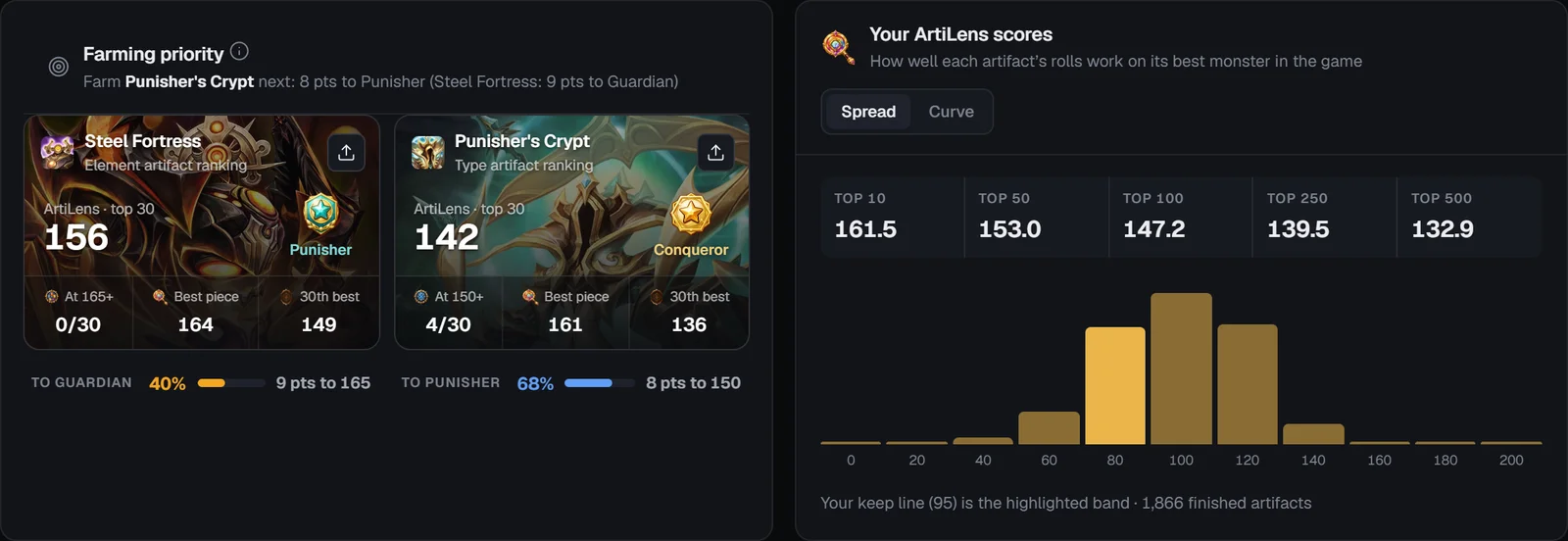
“Your artifact dungeons, graded”: Steel Fortress (element artifacts) and Punisher’s Crypt (type artifacts) each get a rank grade, from Challenger up to Guardian, from the average ArtiLens score of your best pieces of that kind. Farm next is the dungeon with the lower score, with the points it needs for its next grade; when both are at the top grade, farm them for upgrades.
Your ArtiLens scores
“How well each artifact’s rolls work on its best monster in the game”: switch between Spread (how your finished artifacts are spread across the scores, your keep line as a highlighted band) and Curve (your artifacts sorted by score, your keep line dashed), and pick how many of your best artifacts it covers (Top N).
Coverage
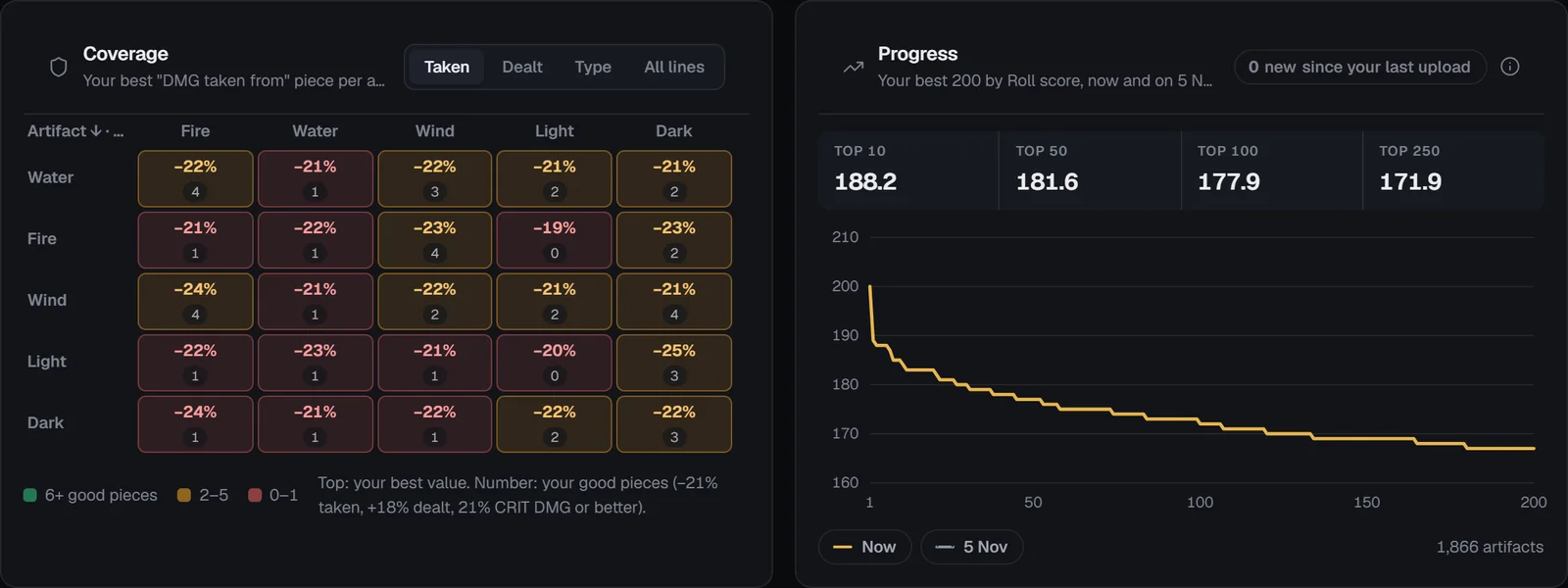
Where your box is thin. Four views:
Each cell shows your best value and how many good pieces you have; an empty one is a gap worth farming. Click a cell to list the artifacts behind it.
Progress
Your best artifacts by Roll score, now and at your last upload: the tiles average your best artifacts and the chart draws them, best on the left, with your last upload underneath. New counts the artifacts new since your last upload — click it to list them.
Your artifacts
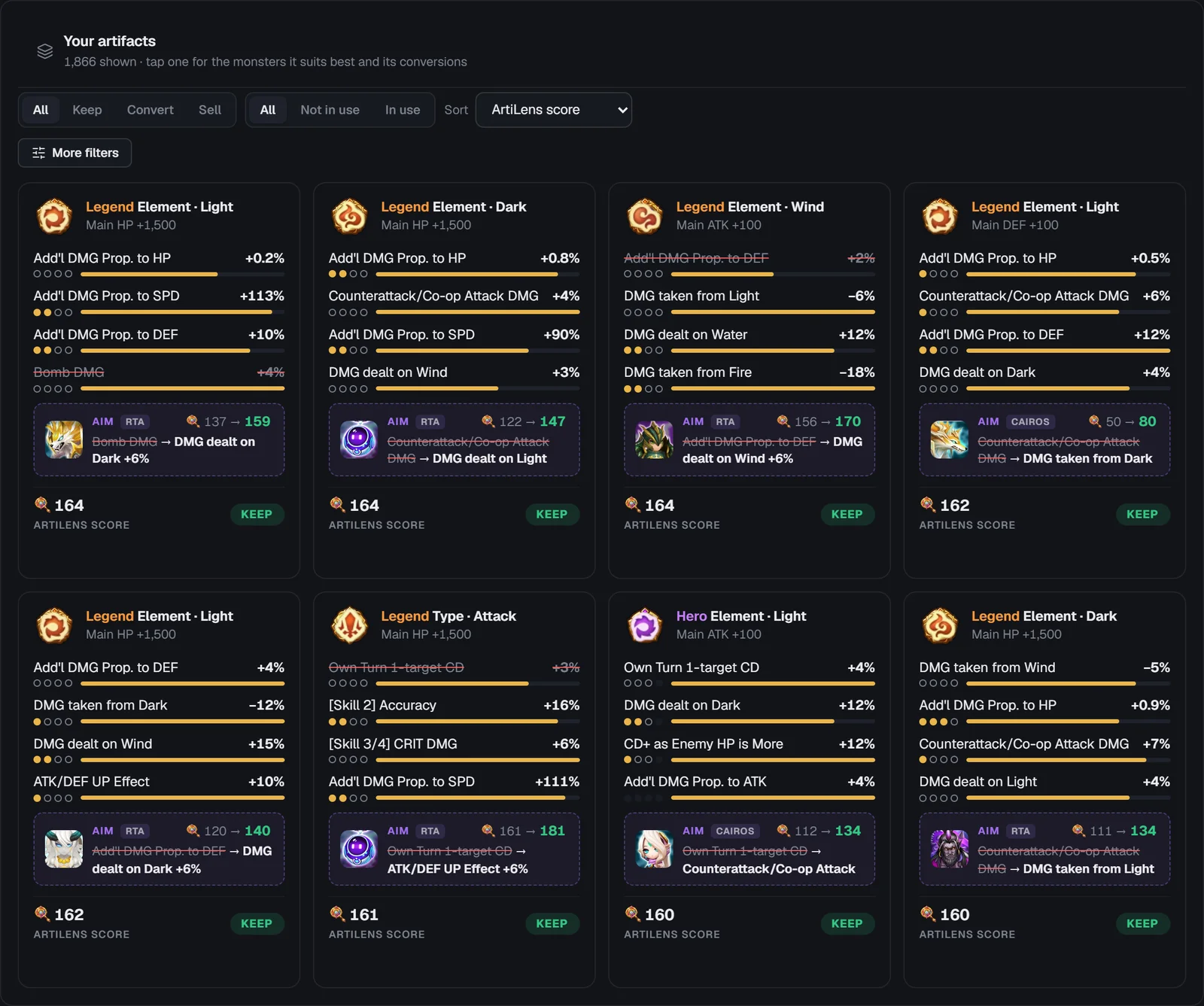
Every artifact, as cards with their verdict, scores and best monster (“Best on …”). Narrow the list down with:
- the verdict (or All), and In use / Not in use;
- More filters — element or type, main property, Lines (all must match) with a minimum value each, converted or not, marked in game or not, and the rolls on one line (double, triple or quad);
- CRIT DMG on one skill, which adds every CRIT DMG line that lands on that skill’s first hit;
- Sort — Newest, Most rolls or Line value (the value of the line you filter by).
Show more loads the rest; click an artifact to open its card.
An artifact’s card
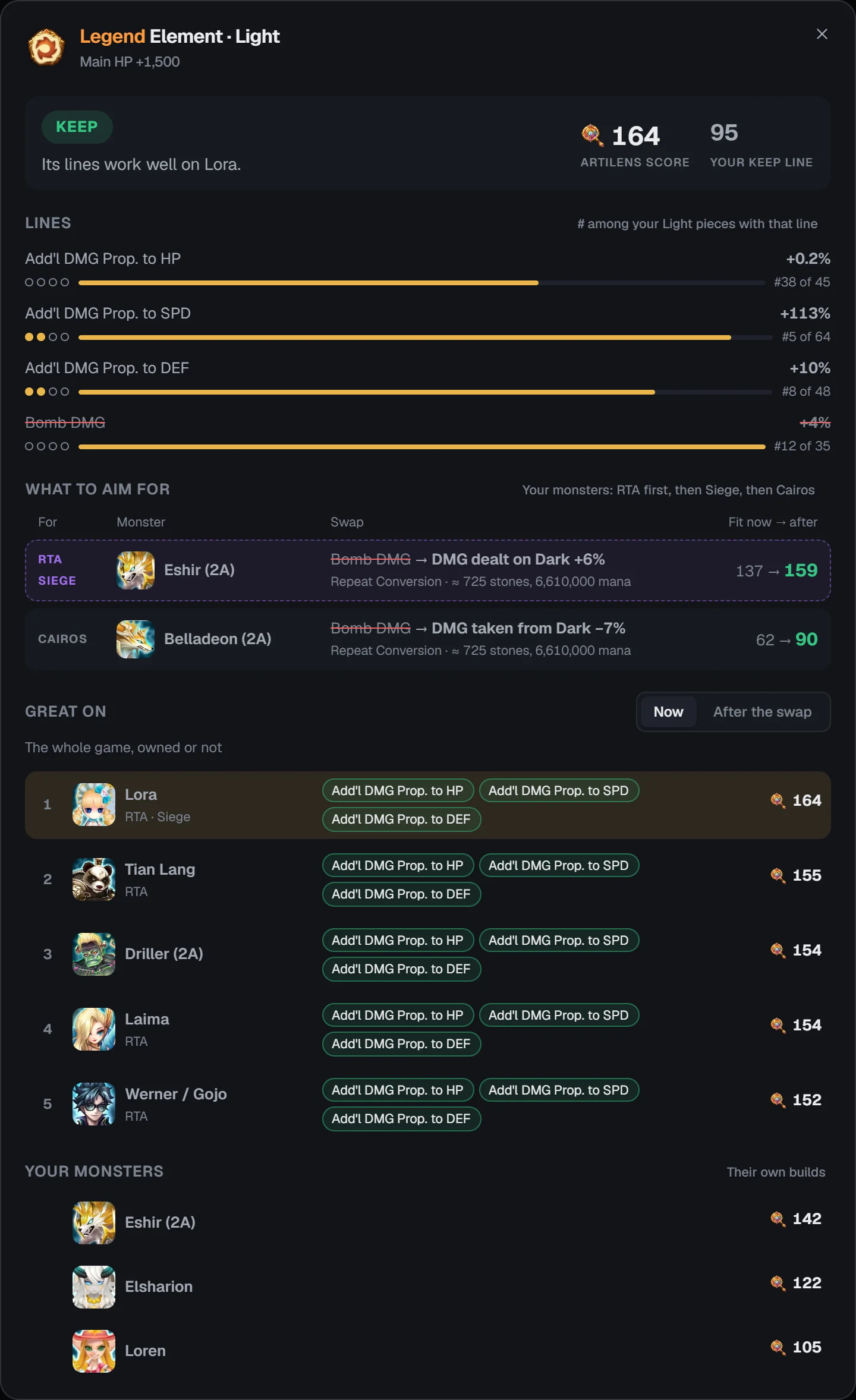
Opening an artifact shows everything Arti Lens knows about it:
- Lines — each line with its rolls and quality, and its rank among your pieces with that line (“#2 of 31”).
- Great on — the monsters it suits best: Your monsters (rated on their own builds) and The whole game, owned or not, each with its fit.
- The swap its card shows — the line to replace and what to put there, with its scores Now and After the swap.
- What to aim for — for your monsters (RTA first, then Siege, then Cairos): the swap that helps each one, and its fit now → after.
- Your keep line — where it stands against it.
Convert & reappraise
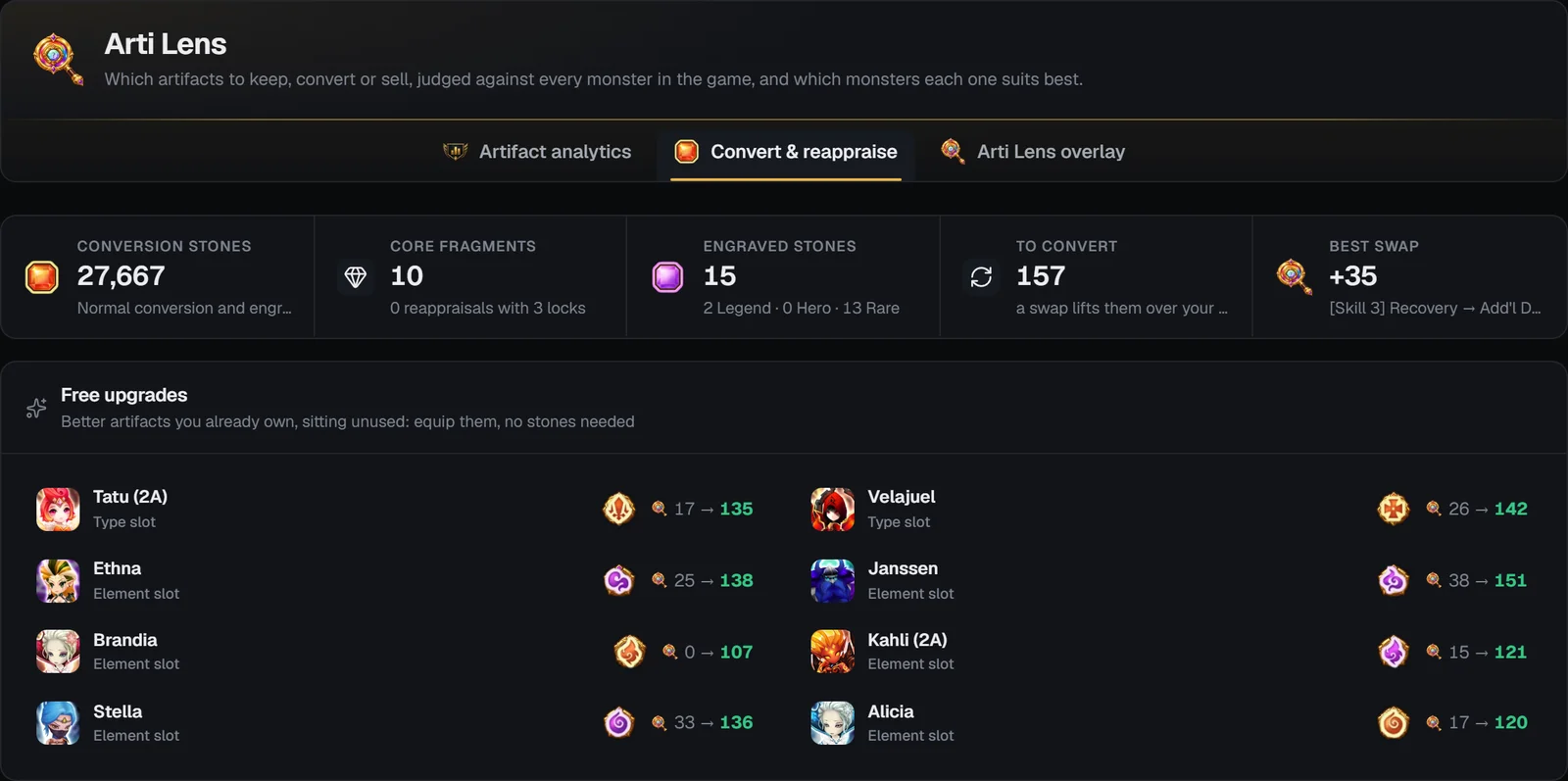
The second tab plans your artifact upgrades. Its strip counts your Conversion Stones, your Core Fragments (and how many reappraisals with locks they pay for), your Engraved stones, the artifacts To convert (“a swap lifts them over your keep line”) and your Best swap — the single swap that adds the most ArtiLens score.
Free upgrades
“Better artifacts you already own, sitting unused: equip them, no stones needed.” For each monster: the element or type slot, the better artifact, and its ArtiLens score on that monster now → with it.
Engraved stones and conversions
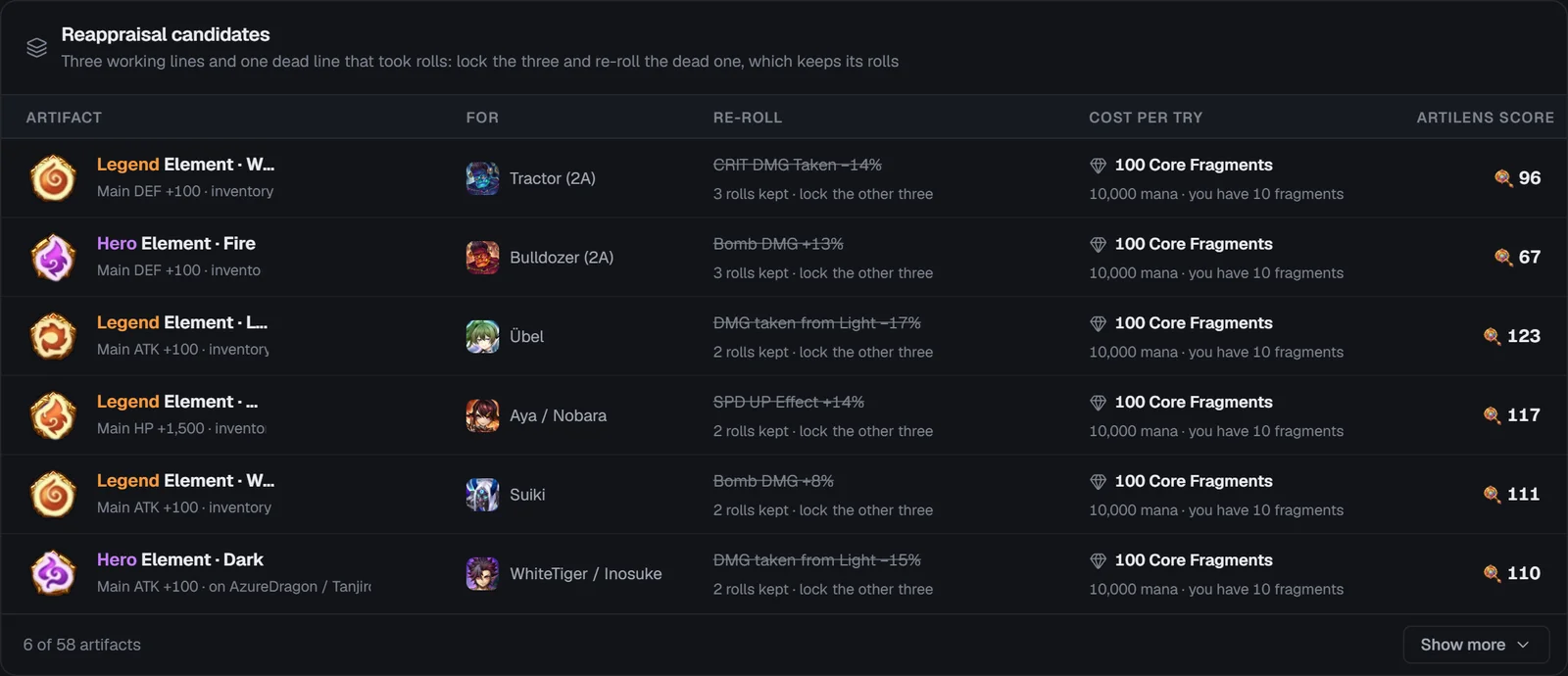
Reappraisal candidates
“Three working lines and one dead line that took rolls”: lock the three and re-roll the dead one, which keeps its rolls. Each candidate shows the line to re-roll, the rolls kept, and the cost per try in Core Fragments and mana.
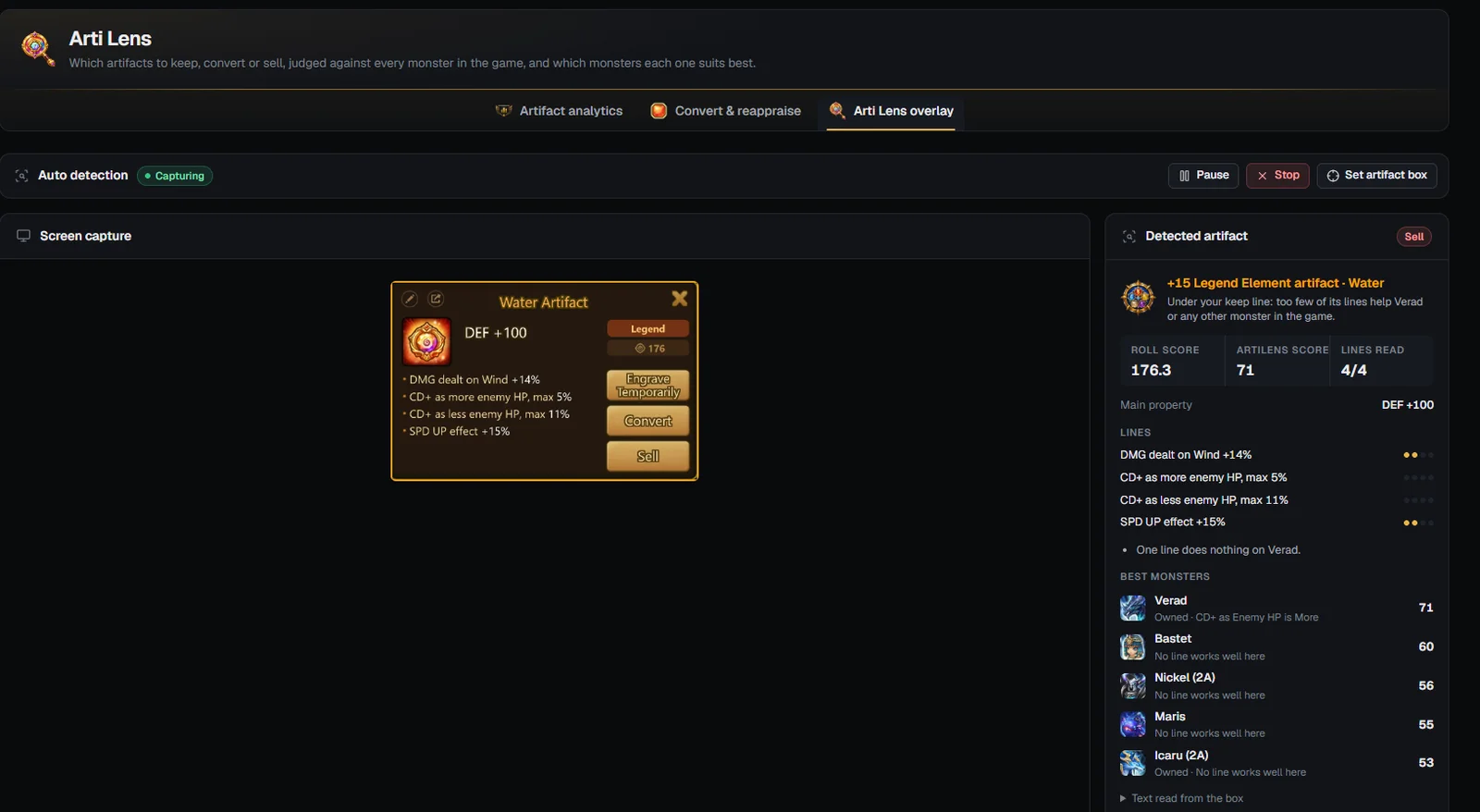
The Arti Lens overlay (web scanner)
The Arti Lens overlay tab reads the artifacts you open in game from your browser. Like Rune Lens, it needs Chrome or Edge on a computer, and Summoners War set to English.
- Press Start and share your Summoners War window.
- Click Set artifact box and drag a box around the artifact’s info card — the panel with its main property and lines.
- Open an artifact in game: it is read as soon as the card stops moving.
Detected artifact shows the lines read, with their rolls, the Roll score and — with your JSON imported — the ArtiLens score, the verdict and the Best monsters, judged like the rest of your box. If a line isn’t on the card, pick the artifact kind and the grade it dropped with yourself.
Arti Lens in the SWLens Client
The free SWLens Client for Windows runs Arti Lens on the game itself: open an artifact and its verdict and scores appear over Summoners War, with no window sharing. See the SWLens Client guide.
On phones
- Artifact analytics shows one card at a time — Farming, Scores, Coverage or Progress — picked above them.
- Tap a coverage cell or an artifact for its pieces and its card.
- The overlay needs a desktop browser: on a phone it opens Artifact analytics instead.
Frequently asked questions
What is Arti Lens?
Arti Lens is the SWLens Summoners War artifact analyzer. It scores every artifact in your box against every monster in the game, gives it a Keep, Convert or Sell verdict against your keep line, names the monsters it suits best and plans your conversions, Engraved stones and reappraisals.
How do artifacts work in Summoners War?
6★ monsters wear two artifacts on top of their runes: an Attribute Artifact matching their element and a Type Artifact matching their type (Attack, Defense, HP or Support). Each has a flat HP, ATK or DEF main property and four sub-properties, and its grade sets how many extra rolls those lines got.
Where do artifacts drop?
In two Cairos dungeons: Steel Fortress drops attribute (element) artifacts and Punisher’s Crypt type artifacts, with Legend artifacts from B9 up.
Is Arti Lens free?
Yes. Arti Lens is free with a SWLens account; it reads the artifacts in your SWEX JSON or SWLens Connect data.
Which artifacts should I sell?
The ones Arti Lens marks Sell: under your keep line, with no conversion that lifts them over, or with too few lines any monster can use. Artifacts in use on your monsters are never marked Sell.
What is the difference between the ArtiLens score and the Roll score?
The Roll score is how well the artifact rolled, on the game’s own Artifact Score scale. The ArtiLens score is how well those rolls work on the artifact’s best monster: a high roll on a line no monster wants scores low.
How do I find the best monster for an artifact?
Open the artifact in Artifact analytics: Great on lists the monsters it suits best among yours and in the whole game, each with its fit, and What to aim for shows the swap that helps each of your monsters.
Which artifacts are worth converting?
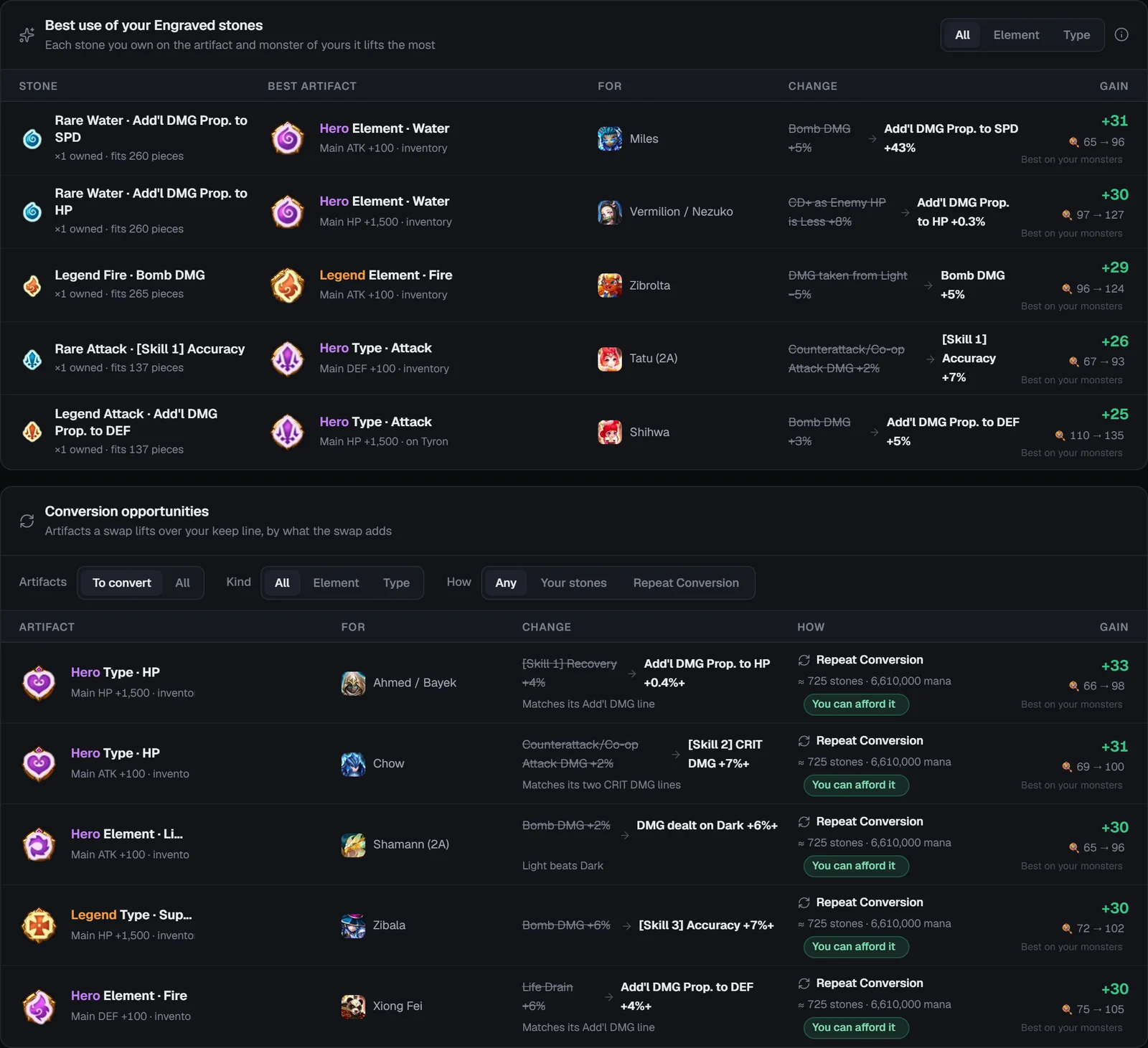
The ones marked Convert: a single swap lifts them over your keep line. The Convert & reappraise tab lists them by what the swap adds, and shows whether a stone you own makes it or normal conversion does, with the cost.
Which artifacts are worth a reappraisal?
Reappraisal candidates have three working lines and one dead line that took rolls: lock the three and re-roll the dead one, which keeps its rolls. The tab shows the cost per try in Core Fragments and mana.
Should I farm Steel Fortress or Punisher’s Crypt?
Farming priority grades both artifact dungeons from your best pieces of each kind, and names the one to farm next and how many points it needs for its next grade.
Related guides


About SWLens Arti Lens
Arti Lens is a free Summoners War artifact analyzer. It scores every element and type artifact in your box against every monster in the game, so a piece is judged on the monster it suits best, and gives it one verdict — keep, convert or sell — against your own keep line. Find the best monster for each artifact, see where your box is thin, grade your farming in Steel Fortress and Punisher’s Crypt, equip free upgrades, plan your artifact conversions and Engraved stones, pick the artifacts worth a reappraisal, and scan each artifact you open in game.
Judge your artifacts
Import your SWEX JSON and see which artifacts to keep, convert or sell — free.
 Rune Lens guide